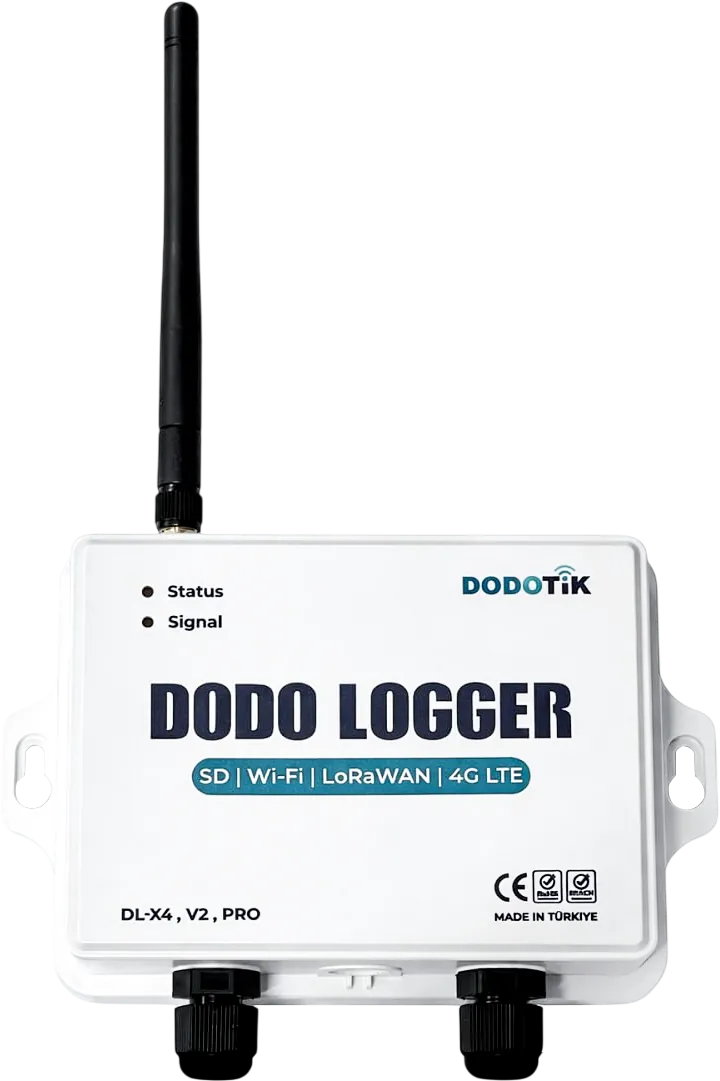
DODO LOGGER
Industrial IoT Sensor Data Logger
SD · Wi-Fi · LoRaWAN · 4G LTE
- 4 universal sensor slots
- RS-485 Modbus + 0-10 V / 4-20 mA
- Wi-Fi, LoRaWAN or 4G LTE
- microSD logging on every variant
- IP68, −20 … +70 °C
- 12-24 VDC, GX12 connectors
Logs to microSD, publishes to the DODOTiK Platform, and shows up in the DODOLINK app — see how.
Overview
The DODO LOGGER is a rugged, field-deployable IoT data logger that reads industrial sensors over RS-485 / Modbus and analog (0-10 V / 4-20 mA) inputs, records every reading to a local microSD card, and delivers data to the cloud over the connectivity option of your choice - Wi-Fi, LoRaWAN, or 4G LTE.
It is built for unattended, 24/7 operation in agriculture, greenhouses, irrigation, water and reservoir monitoring, cold chain, environmental and industrial-process work. A built-in web dashboard lets an installer configure the device and watch live readings from a phone or laptop with no app to install, and a fully offline mode lets the logger run as a self-contained recorder with no internet at all.
The part that saves an integration project is the no-code sensor library: a new Modbus sensor is added from the web interface, not by reflashing firmware. The logger then self-describes its schema to the DODOTiK Platform, so that sensor appears in the dashboard and in the DODOLINK app with no backend deployment and no app update.
Three versions, one product. Wi-Fi, LoRaWAN and 4G LTE differ only in the uplink radio fitted - firmware, web interface, enclosure, sensor inputs and connectors are identical. All three log to microSD, so every variant keeps a complete local record whether or not the uplink is up. The DL-X4 PRO adds on-board relay outputs, so one unit both reads sensors and switches pumps, valves or lighting.
Key features
- Three versions - Wi-Fi, LoRaWAN, 4G LTE - same hardware and firmware, different uplink radio; all three log to microSD
- 1 to 4 sensors per logger - 4 universal slots, each independently configurable as Modbus or analog
- No-code sensor library - add new Modbus sensors from the web UI, with no firmware reflash
- Local and cloud - SD-card logging always on; cloud delivery optional and selectable
- Works fully offline - local Wi-Fi access point plus SD logging, zero internet required
- Schema-discovery cloud - the device self-describes; the platform renders any sensor with no backend changes
- Secure by default - TLS to the cloud, signed OTA firmware updates, WPA2-protected local access
- Multi-protocol cloud - DODOTiK Platform (MQTT/TLS) or your own HTTPS endpoint
- Battery-backed real-time clock - timezone-aware timestamps, automatic NTP calibration when online
Technical specifications
Sensor inputs and I/O
| Parameter | Value |
|---|---|
| Sensor slots | 4 universal slots, each assignable to Modbus or analog |
| Modbus socket | GX12 4-pin - RS-485 multi-drop, up to 4 sensors daisy-chained, each on its own slave address |
| Analog socket | GX12 4-pin - AN0 (0-10 V) and AN1 (4-20 mA), up to 2 sensors, one per channel |
| Modbus role | Modbus RTU master, function codes 0x03 (holding) and 0x04 (input) |
| Per-sensor settings | Slave address and baud rate configurable per sensor |
| Sensor library | Built-in presets plus user-defined sensors added from the web interface |
Data logging
| Parameter | Value |
|---|---|
| Media | Removable microSD card (FAT), up to 32 GB — card not included |
| Format | CSV, one column per enabled sensor field, with header and timestamp columns |
| File rotation | Daily — /sensors-YYYYMMDD.csv |
| Timestamps | Local time, so files open with the site's wall-clock time |
| Logging interval | Configurable, default 60 s, minimum 5 s |
| Hot-plug | Insert or remove the card without rebooting; logging auto-resumes |
| Power-loss handling | Explicit flush-before-close on every write |
Cloud and connectivity
| Parameter | Value |
|---|---|
| DODOTiK Platform | MQTT over TLS — retained schema, periodic telemetry, status online/offline LWT |
| Your own server | HTTPS POST of self-describing JSON, optional Bearer token; TLS mandatory, plain HTTP refused |
| Verification | Built-in Test Send button checks the endpoint before going live |
| Web interface | Browser dashboard, no app — Setup Mode (http://192.168.4.1/), Online Mode (http://dodo-logger-XXXX.local/ via mDNS), Offline Mode |
Power
| Parameter | Value |
|---|---|
| Supply voltage | 12-24 VDC |
| Power connector | GX12 aviation connector, 2-pin (1: VCC · 2: GND) |
| Sensor supply output | Pass-through of input voltage (12 V in → 12 V out; 24 V in → 24 V out) |
| Reverse-polarity protection | Yes |
| Power consumption | Varies with the number and type of connected sensors |
Processing and memory
| Parameter | Value |
|---|---|
| Program memory | 16 MB onboard flash |
| Configuration storage | Non-volatile — settings and sensor library survive power loss |
| Data storage | Removable microSD card, up to 32 GB (not included) |
Wireless — Wi-Fi variant
| Parameter | Value |
|---|---|
| Wi-Fi | 802.11 b/g/n, 2.4 GHz |
| Access-point mode | WPA2 (offline / setup), unique SSID per device |
| Local discovery | mDNS (.local) |
Wireless — LoRaWAN variant
| Parameter | Value |
|---|---|
| Module | RAK3172 |
| Frequency band | EU868 |
| Class | Class A |
| Activation | OTAA / ABP (configurable) |
| Range | Up to 10 km (line of sight) |
Wireless — 4G LTE variant
| Parameter | Value |
|---|---|
| Modem | A7670G (LTE Cat-1) |
| Bands | Global multi-band LTE |
| Fallback | 2G (GSM) |
| SIM | Full-size (standard) SIM card |
Mechanical and environmental
| Parameter | Value |
|---|---|
| Enclosure | Wall-mount, flanged tabs |
| Material | ABS |
| Ingress protection | IP68 |
| Dimensions (L × W × H) | 150 × 45 × 95 mm |
| Weight | 150 g |
| Operating temperature | −20 … +70 °C |
| Humidity | 0-95 % RH (non-condensing) |
Logged on the card, live on the platform, in your pocket
A sensor is selected in the logger's web interface and starts recording. The logger then describes its own schema to the platform, so that sensor appears in the dashboard and in the app with no backend deployment and no app update.
No-code sensor library
Add a Modbus sensor from the web UI — address, baud, registers and scaling as configuration. No firmware reflash.
microSD, always on
Every reading to the card, offline included, in daily-rotated CSV. Logging never depends on the uplink.
DODOTiK Platform
MQTT/TLS — live dashboards, full history, alert thresholds and device management across every logger on the account.
DODOLINK app
The same readings and alerts on iOS and Android, for whoever is in the field rather than at a desk.
Or your own server
HTTPS POST of self-describing JSON to your endpoint, with optional Bearer auth. Test Send verifies it before you go live.
Nothing here is lock-in. The logger speaks standard Modbus RTU to standard sensors and can publish to your own HTTPS endpoint instead of ours. The platform and the app are the fastest route from sensor to dashboard, not the only one.
Documentation
Ungated — no form, no email address required. Open them, read the register maps, and decide before you talk to us.
Applications
Smart agriculture and greenhouses - soil NPK, moisture, temperature and humidity
Irrigation and water-reservoir monitoring - level, pressure, flow and water quality
Environmental and air-quality monitoring - fixed stations and research networks
Cold chain and warehouse logging - unattended recording with a local audit trail
Industrial process and utility metering - any Modbus or 4-20 mA sensor
Before you specify it
Limits worth knowing before the order goes in, rather than after the sensor is in the ground.
- At most 2 analog sensors, and because the channels are fixed-function those two must be one 0-10 V sensor and one 4-20 mA sensor. Everything else goes on the Modbus bus.
- The microSD card and the power supply are not included.
- The Wi-Fi variant is the one fully specified against verified firmware behaviour; the LoRaWAN and 4G LTE variants share the same sensor inputs, SD logging, enclosure and configuration workflow.
Ordering information
| Order code | Description |
|---|---|
| DL-X4-V2-WIFI | DODO LOGGER, 4 universal slots, Wi-Fi uplink |
| DL-X4-V2-LORA | DODO LOGGER, 4 universal slots, LoRaWAN uplink (RAK3172, EU868) |
| DL-X4-V2-4G | DODO LOGGER, 4 universal slots, 4G LTE uplink (A7670G) |
| DL-X4-PRO | PRO - combined sensor and relay unit: sensing inputs and up to 32 relay outputs (16 A @ 250 VAC, NO/NC) in one device |
What's in the box
- DODO LOGGER unit
- External antenna (included)
- Quick-start guide
Quality and warranty
- Conformity assessment - CE (RED/EMC), RoHS and REACH assessment is carried out per production order; the Declaration of Conformity and test reports are issued with the first volume shipment
- Destination-market type approval - where the destination country operates its own approval scheme, this is arranged per market; please ask
- Made in Türkiye
- Warranty: 1 year
Frequently asked questions
How many sensors can one DODO LOGGER read?
Four. There are 4 universal slots and each is independently assignable to a Modbus sensor or an analog input. Any mix totalling 4 or fewer works - 4 Modbus; 3 Modbus + 1 analog; 2 Modbus + 2 analog; or a single sensor on its own. Empty slots cost nothing and are simply not logged. The one extra ceiling is the analog socket's two fixed-function channels, so at most 2 analog sensors: one 0-10 V and one 4-20 mA.
Does DODO LOGGER work without internet?
Yes. SD-card logging is always on and runs with no connectivity at all. In offline mode the logger raises its own WPA2 access point, so an installer can open the web dashboard on a phone, see live readings and download the CSV straight off the card. Cloud delivery is optional and selectable.
Do I need to reflash the firmware to add a new sensor?
No. New Modbus sensors are added from the web interface using the no-code sensor library - slave address, baud rate, registers and scaling are entered as configuration. The logger then publishes its own schema to the DODOTiK Platform, so the new sensor appears in the dashboard and in the DODOLINK app with no backend deployment and no app update.
Can DODO LOGGER send data to my own server instead of the DODOTiK Platform?
Yes. The logger can POST self-describing JSON to any HTTPS endpoint you own, with optional Bearer-token authentication. TLS is mandatory and plain HTTP is refused. A built-in Test Send button verifies the endpoint before you go live, and the integration guide includes Express, FastAPI and Node-RED receiver recipes.
What is the difference between the Wi-Fi, LoRaWAN and 4G LTE versions?
Only the uplink radio. Firmware, web interface, enclosure, sensor inputs and connectors are identical, and all three log to microSD. Choose Wi-Fi for sites with an existing network, LoRaWAN (RAK3172, EU868) for long-range low-power links with no local network, and 4G LTE (A7670G) for remote sites with no Wi-Fi or LAN.
What does the PRO version add?
DL-X4-PRO is a combined sensor and relay unit: the same sensing inputs plus up to 32 relay outputs rated 16 A at 250 VAC, NO/NC. One device both reads sensors and switches loads such as pumps, valves and lighting.
How do I order DODO LOGGER, and what does it cost?
DODO LOGGER is sold direct and through distributors. Pricing depends on the variant and quantity, so request a quote with the order code (DL-X4-V2-WIFI, DL-X4-V2-LORA, DL-X4-V2-4G or DL-X4-PRO) and the quantity you need, and DODOTiK will come back with export pricing, volume tiers and lead time.
Request a quote for DL-X4-V2
Sold direct and through distributors. Tell us the order code, the quantity and the destination country and we will come back with export pricing, volume tiers and lead time.